
The Government Of Lampung Province
LAMPUNG PROVINCIAL GOVERNMENT STRENGTHENS INVESTMENT CLIMATE THROUGH BUREAUCRATIC REFORM AND NATURAL RESOURCE DOWNSTREAMING
Investment performance in Lampung Province has continued to show a positive trend in recent years. In 2023, realized investment reached Rp10.8 trillion. A year later, the realization stood at Rp9.66 trillion, or 74.54 percent of the target. Meanwhile, in the first quarter of 2025, incoming investment ranged between Rp3.3 trillion and Rp3.5 trillion, with Foreign Direct Investment (FDI) contributing Rp651.6 billion. This achievement placed Lampung in fourth position within the Sumatra region.
Lampung’s priority investment sectors include agriculture, plantations, manufacturing, renewable energy, fisheries, and logistics. The province is widely recognized as one of Indonesia’s national food barns, with leading commodities such as coffee, pepper, pineapple, cassava, rubber, and sugarcane. In addition, green energy potential has become a new attraction for investors, including geothermal development in Ulubelu and the planned construction of a floating solar power plant at the Marga Tiga Dam.
To strengthen the investment climate, the Lampung Provincial Government established the Lampung Investment Forum (FOILA), chaired by the Regional Secretary of Lampung Province, Marindo Kurniawan. The forum plays a strategic role in accelerating downstream processing and increasing the added value of natural resources, particularly in the agricultural sector, which currently contributes around 29 percent to Lampung’s Gross Regional Domestic Product (GRDP).
As a concrete step to improve services and facilitate investment, in July 2025 the Lampung Provincial Government inaugurated the Public Service and Licensing Center (P4). The presence of P4 is expected to streamline bureaucratic procedures, accelerate licensing processes, improve service quality, and prevent illegal levies.
Through these various efforts, the Lampung Provincial Government remains optimistic about maintaining the positive trend in investment performance and attracting more investors to support sustainable regional economic growth.
Prioritizing Road Development to Accelerate Economic Growth and Food Security
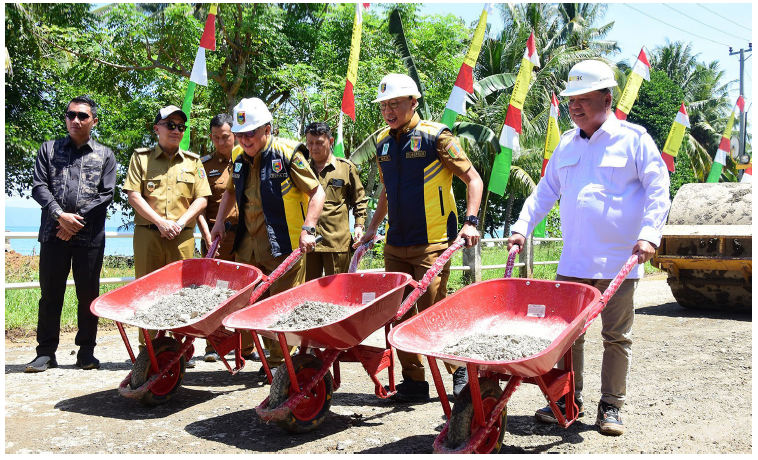
Infrastructure development, particularly road construction, remains a top priority for the Lampung Provincial Government in its efforts to accelerate development across the province’s 15 regencies and cities.
The Governor of Lampung, Rahmat Mirzani Djausal, emphasized that well-developed road infrastructure will have broad impacts on the development of various strategic sectors, ranging from social development and agriculture to regional development and food security.
“Road infrastructure development is a crucial factor in driving regional economic growth. Good roads facilitate the distribution of goods, improve community mobility, and open wider access for farmers to enhance their welfare,” the Governor said.
According to him, improving farmers’ welfare is not only determined by market access, product management, or technology, but is also strongly influenced by the availability of quality roads. With adequate infrastructure, rural economic activities can grow more rapidly and provide a tangible contribution to the regional economy.
 In 2023, Lampung Province received infrastructure improvement support from the Central Government through the Regional Road Presidential Instruction Program (Inpres Jalan Daerah/IJD) amounting to Rp806.2 billion for 16 road segments. The program successfully increased road stability in Lampung to 78.81 percent, rising from 78.67 percent at the end of 2023 and 76 percent at the end of 2022.
For 2025, the Ministry of Public Works (PU) received a budget allocation of Rp10.21 trillion for the Regional Road Presidential Instruction Program. The funds cover the implementation of physical works in 2025 as well as the fulfillment of Multi Years Contract (MYC) projects running until 2026.
The program will soon be implemented after President Prabowo Subianto signs Presidential Instruction (Inpres) No. 11 of 2025 concerning the acceleration of regional road connectivity improvements to support food and energy self-sufficiency. The program is scheduled to begin in October 2025.
Of the total allocation, Rp9.91 trillion is designated for 439 physical projects, while Rp297 billion is allocated for technical support. The implementation target includes the improvement of 1,611 kilometers of roads and the construction of 458 meters of bridges.
The 2025 IJD implementation will be carried out in three stages. Stage II includes a budget of Rp3.03 trillion for the construction of 511.40 kilometers of roads, while Stage III is planned at Rp1.62 trillion for the construction of 282 kilometers of roads and a 30-meter bridge. Lampung Province is once again confirmed as one of the regions receiving this budget allocation.
With continued support from the Central Government and the strong commitment of the Regional Government, road infrastructure development in Lampung Province is expected to strengthen connectivity, support food security, and accelerate sustainable regional economic growth. (**)
THROUGH PROGRAM INNOVATION AND STRATEGIC POLICIES
THE LAMPUNG PROVINCIAL GOVERNMENT STRENGTHENS EDUCATION TRANSFORMATION

The leadership era of Governor Rahmat Mirzani Djausal marks a new milestone in the history of education in Lampung, where the education sector is not only becoming a locomotive of development but has also proven capable of reducing regional inflation while strengthening the community’s future competitiveness.
The Lampung Provincial Government continues to reinforce concrete measures to improve the quality and equitable distribution of education. Several strategic policies and programs have been implemented, including the establishment of model schools, expansion of education access through Kelas Cangkok (Grafting Classes), the creation of skilled workers through Migrant Vocational Classes, and the achievement of significant deflation in the education sector. These breakthroughs demonstrate the government’s commitment to creating an inclusive, equitable, and competitive education system.
Strategic Policy of Eliminating School Committee Fees Drives Education Deflation
A historic achievement occurred in Lampung Province in 2025. For the first time, the education sector became a contributor to inflation control, recording a significant deflation of 15.10 percent.
Data from Statistics Indonesia (BPS) shows that the education sector price index fell from 108.59 in August 2024 to 92.19 in August 2025. This phenomenon occurred during the leadership of Governor Rahmat Mirzani Djausal, who boldly implemented a strategic policy to abolish school committee fees.
Overall, Lampung’s year-on-year inflation (y-on-y) in August 2025 reached only 1.05 percent, lower than the 2.33 percent recorded during the same period the previous year.
However, the most striking factor was the role of the education sector in controlling regional inflation. Of the four subgroups, two experienced deflation, namely basic education and early childhood education, which declined by 1.77 percent, and secondary education, which fell sharply by 51.23 percent. Meanwhile, higher education increased by 11.95 percent, and other education services rose by 4.30 percent.
Overall, the education sector contributed 0.98 percent deflation (y-on-y), mainly due to reduced costs at the elementary, junior high, and senior high/vocational school levels.
The Head of the Lampung Provincial Communication, Information, and Statistics Office, Ganjar Jationo, emphasized that the abolition of school committee fees was the key factor behind this achievement.
“The success in creating deflation in the education sector is a clear symbol of the Lampung Provincial Government’s commitment to the people. Financial burdens have been reduced, purchasing power has increased, and public trust in the regional government has grown stronger,” he said.
He explained that education deflation was also driven by the optimization of education subsidies and assistance programs, such as School Operational Assistance (BOS), regional scholarships, and the elimination of school contributions. Besides easing household expenses, this policy also helps suppress regional inflation while strengthening the long-term direction of human resource development.
Designation of 35 Model Schools
In an effort to improve the quality of secondary education, the Lampung Provincial Department of Education and Culture (Disdikbud) has designated 35 Senior High Schools (SMA) as model schools. This designation coincides with the implementation of the New Student Admission System (SPMB), which replaces the previous PPDB system, based on Regulation of the Minister of Primary and Secondary Education No. 3 of 2025 and Governor of Lampung Decree No. G/289/V.01/HK/2025.
“The model schools were selected based on consistent academic quality, the availability of facilities and infrastructure, as well as achievement records. This designation is expected to serve as a guide for the public in choosing schools while also encouraging improvements in the quality of secondary education in Lampung,” explained the Head of the Lampung Provincial Education and Culture Office, Thomas Amirico.
Kelas Cangkok: Expanding Educational Access for 3T Regions
The Lampung Education and Culture Office has also launched the Kelas Cangkok (Grafting Class) Program, aimed at outstanding students from disadvantaged, frontier, and outermost regions (3T) such as Way Kanan, Pesisir Barat, Mesuji, and Tanggamus.
The program targets students from underprivileged families, allowing them to study at model schools in Bandar Lampung with full funding from the Regional Budget (APBD). The support covers accommodation, meals, and education costs for one year.
He added, “Students remain officially registered at their original schools. After completing their examinations, they will return to their home regions to motivate their peers. This is one of the concrete steps toward achieving equitable education in Lampung.”
Migrant Vocational Classes: Responding to the Demographic Bonus and Becoming a National Model
As a proactive step to address the demographic bonus, the Lampung Provincial Government has launched the Migrant Vocational Class Program for SMA and SMK students. The program receives full support from the Ministry for the Protection of Indonesian Migrant Workers (P2MI) and has become the first national pilot program in Indonesia.
The Governor of Lampung, Rahmat Mirzani Djausal, stated that of Lampung’s 9.4 million population, about 70 percent are of productive age. However, there remains a gap between the number of high school graduates and the availability of employment opportunities.
“If not anticipated early, the demographic bonus could become a burden. The Migrant Vocational Class is a real solution to prepare Lampung’s younger generation to become highly skilled human resources ready to compete in the global labor market,” Rahmat emphasized.
The program has attracted 8,500 applicants and is supported by 44 Japanese language teachers. A Memorandum of Understanding (MoU) between the Lampung Provincial Government and the Ministry of P2MI has also been signed, covering cooperation in labor placement to Japan, South Korea, and several European countries.
The Minister of P2MI, Abdul Kadir Karding, praised Lampung’s initiative.
“This province does not stop at discourse but immediately moves with concrete action. Lampung deserves to become a national model,” he stated.
In addition to the Migrant Class, the Lampung Provincial Government has also introduced digital innovations through the RMD Application and Aksi Jihan to support the digitalization of education and prepare students for the global job market.
Various policies and innovations implemented by the Lampung Provincial Government demonstrate that education development is a top priority in building high-quality human resources. From the policy of abolishing school committee fees, the designation of model schools, the Kelas Cangkok program, to the Migrant Vocational Class, all initiatives are aimed at providing more affordable, equitable, and high-quality education.
LAMPUNG STRENGTHENS ECONOMIC GROWTH
THROUGH EDUCATION, TOURISM, INVESTMENT, AND INFRASTRUCTURE
 The Lampung Provincial Government continues to maximize various efforts to achieve inclusive and sustainable regional economic growth. By strengthening the sectors of education, tourism, investment, and infrastructure development, Lampung is increasingly affirming its position as one of the strategic growth centers in Sumatra.
Lampung’s economic performance in the second quarter of 2025 recorded growth of 5.09 percent, surpassing the average growth of the Sumatra region. This achievement reflects Lampung’s commitment to maintaining the momentum of economic recovery while strengthening its role as a national food barn and a major production center for strategic commodities.
Tourism: Surpassing Domestic Tourist Targets
Lampung’s tourism sector has also achieved remarkable success. Throughout 2024, the number of domestic tourist visits reached 17.87 million, far exceeding the initial target of 7.85 million visitors.
This success was driven by intensive promotion, destination development, and the organization of various flagship events. The SIGER Madani Program (Synergy Movement to Enhance Inclusive Tourism Villages) has successfully empowered tourism villages such as Rigis Jaya in West Lampung and Karya Penggawa in Pesisir Barat. As a result, tourist visits have increased significantly while strengthening ecotourism and culture-based creative economies.
The Lampung Bumi Event strategy has also boosted the region’s tourism appeal. Krakatau Festival, Tubaba Art Festival, and the Sekala Bekhak Festival, which are included in the National Event Calendar (KEN), have successfully attracted thousands of visitors. Meanwhile, leading destinations such as Pahawang Beach, Way Kambas National Park, and Kiluan Bay remain major tourist magnets.
With these achievements, Lampung is increasingly recognized as a leading national tourism destination, contributing to foreign exchange earnings while strengthening the local economy through creative industries and UMKM.
 Lampung Becomes a Center of Economic Growth in Sumatra
Investment performance in Lampung Province continues to show a positive trend. In 2023, realized investment reached Rp10.8 trillion. A year later, the realization stood at Rp9.66 trillion, or 74.54 percent of the target. Meanwhile, in the first quarter of 2025, investment realization ranged between Rp3.3 trillion and Rp3.5 trillion, with Foreign Direct Investment (FDI) contributing Rp651.6 billion. This achievement placed Lampung in fourth position in Sumatra.
Priority investment sectors include agriculture, plantations, manufacturing, renewable energy, fisheries, and logistics. Lampung is widely known as a national food barn, with leading commodities such as coffee, pepper, pineapple, cassava, rubber, and sugarcane. Green energy potential, including geothermal development in Ulubelu and the planned floating solar power plant at Marga Tiga Dam, has also become a new attraction for investors.
To strengthen the investment climate, the Lampung Provincial Government established the Lampung Investment Forum (FOILA), chaired by the Regional Secretary of Lampung Province, Marindo Kurniawan. The forum aims to accelerate downstream processing and increase the added value of natural resources, particularly in the agricultural sector, which contributes around 29 percent to Lampung’s Gross Regional Domestic Product (GRDP).
In addition, in July 2025, the Lampung Provincial Government inaugurated the Public Service and Licensing Center (P4) as a concrete step to streamline bureaucracy, improve service quality, and prevent illegal levies.
Roads Become the Top Priority
Infrastructure development, especially road construction, remains a top priority for the Lampung Provincial Government in supporting accelerated growth across 15 regencies and cities.
Governor Rahmat Mirzani Djausal emphasized that well-developed road infrastructure will have broad impacts on the development of strategic sectors ranging from social development and agriculture to regional development and food security.
“Road infrastructure development is a crucial factor in driving regional economic growth. Good roads facilitate the distribution of goods, improve community mobility, and open wider access for farmers to enhance their welfare,” he stated.
According to him, improving farmers’ welfare is not only determined by market access, product management, and technology, but is also strongly influenced by the availability of quality road infrastructure. With adequate roads, rural economic activities can grow more rapidly and contribute directly to the regional economy.
For reference, in 2024, Lampung Province received support for road infrastructure improvement from the central government through the Regional Road Presidential Instruction Program (Inpres Jalan Daerah/IJD) amounting to Rp806.2 billion for 16 road segments. The program contributed to improving road stability in Lampung, which reached 78.81 percent in 2024, increasing from 78.67 percent at the end of 2023 and 76 percent in 2022.
DEVELOPMENT DIRECTION OF THE LAMPUNG PROVINCIAL GOVERNMENT 2025–2030
 The Governor of Lampung, Rahmat Mirzani Djausal, together with Vice Governor Jihan Nurlela, has established the regional development vision and mission for the 2025–2030 leadership period.
The vision adopted is “Together, an Advanced Lampung Towards Indonesia Emas 2045,” which will guide regional development over the next five years.
To realize this vision, the regional leadership has formulated three main missions known as the “Three Aspirations (3 Cita)”, which also serve as the strategic work programs of the Lampung Provincial Government.
First Aspiration: Inclusive, Independent, and Innovative Economic Growth
The Lampung Provincial Government aims to accelerate economic development through increased investment and industrial downstreaming, strengthen Lampung’s role as a national food barn, and build a village-based economic ecosystem.
In addition, the tourism and creative economy sectors are being encouraged as drivers of regional growth, alongside initiatives to develop renewable energy hubs.
Second Aspiration: Strengthening Excellent and Productive Human Resources
Development efforts focus on shaping a smart, ethical, and culturally grounded generation. The government also promotes the emergence of competitive young entrepreneurs, supports youth achievements and sports development, targets zero stunting and a healthy society, and aims to position Lampung as an integrated technology center.
Third Aspiration: A Civilized, Just, and Sustainable Society
This program emphasizes strengthening the spirit of community solidarity in Lampung, implementing timely and targeted poverty alleviation, reinforcing family resilience, and improving environmental quality.
The government is also committed to building a bureaucracy with integrity, continuing the development of Kotabaru Bandar Negara as an eco-city, and ensuring the protection and fulfillment of the rights of children, women, persons with disabilities, the elderly, and other vulnerable groups.
