
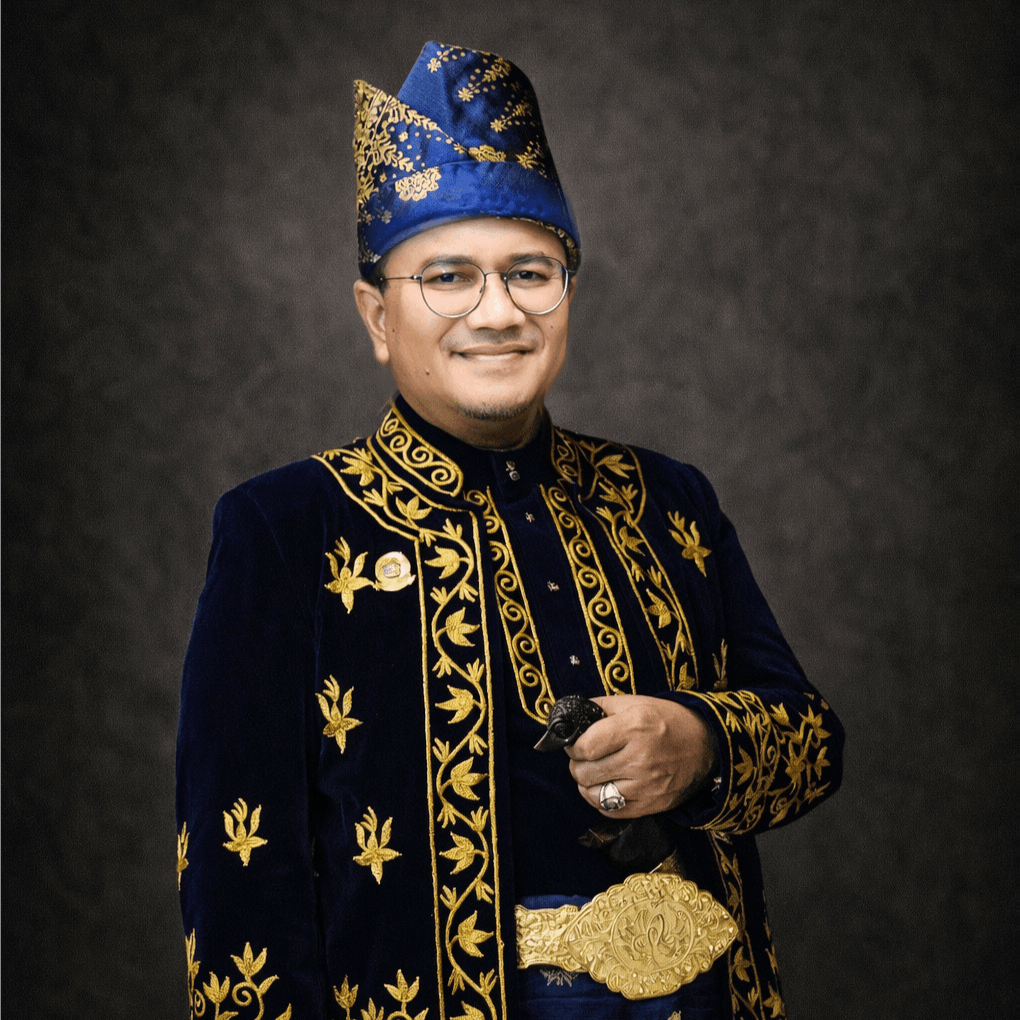
THE MAYOR’S VISION
THE EMERGING MALAY CITY OF HARMONY AND OPPORTUNITY
“Between river and memory, Jambi finds its future.”
Preserving Roots, Building the Future On the banks of the Batanghari River, which flows gently yet holds the long memory of civilization, the city of Jambi stands as a space inhabited not only by people, but also by history. The river is not merely a stream of water, but a pathway once traversed by ideas, trade, and cultural encounters that shaped the face of the Malay world.
“Jambi, a city that continues to grow without losing its origins.”
From the riverbanks to the Muaro Jambi Temple complex, traces of past civilizations still whisper softly. It was here, in earlier times, that knowledge and commerce met within the same pulse. Jambi is not merely a part of Malay history—it is one of its roots.
Today, amid the swift currents of modernization, the city of Jambi is rediscovering a long-delayed role: becoming a node that connects the past with the future of the Malay world. “Jambi is not only part of Malay history, but one of the roots of that civilization.”
Thus unfolded a conversation with the Mayor of Jambi, Dr. dr. H. Maulana, MKM—a dialogue that went beyond the boundaries of questions and answers. In every exchange with a leader, there are always deeper layers: a worldview shaped by experience, a rhythm of thought tested by time, and a direction of vision that gradually reveals itself through measured words. With Maulana, the conversation did not stop at the realm of policy alone, but flowed as a reflection of a growing awareness—of how a city is not only built, but also interpreted, guided, and prepared for a broader future.

With a composed and steady tone, each sentence he delivered felt like a chain of thoughts forged through long experience and reflection. Neither rushed nor excessive, yet carrying a clear direction—a vision of how Jambi does not merely grow as a city, but also reclaims its place within the wider landscape of Malay civilization.
The words that flowed from his speech were not merely responses, but carefully structured ideas—linking history, identity, and the future. In every thought expressed, there was an implicit conviction that urban development is not only about achieving physical progress, but about nurturing values, building trust, and opening space for future generations to continue the journey with greater strength and meaning.
In the view of the Mayor of Jambi, this position is not merely a source of historical pride, but a responsibility that must be translated into concrete steps for urban development.
Amid the city’s rapid growth, balance becomes the key word. Economic development, technological advancement, and the preservation of cultural values must not run separately. “We do not see modernization as something that should sever tradition, but as a space to strengthen identity.”


 The Jambi City Government has chosen a path that does not separate modernity from values. On one hand, economic growth is driven through the trade and services sectors; on the other, digital transformation is pursued through the smart city concept. Yet, Malay identity remains the foundation. It is present in symbols, in policies, and in the way the city shapes its own character. “Custom is founded upon Islamic law, and Islamic law is founded upon the Book of God remains the spirit in every direction of the city’s development,” the Mayor affirmed.
Jambi’s vision does not stop at administrative boundaries. The city is being directed to become a hub for trade and services that is open, competitive, and regionally competitive. Strategic steps continue to be taken—simplifying licensing processes, developing economic zones, and improving infrastructure that supports connectivity. “We want Jambi to become a city that not only grows, but is also trusted as an open and promising economic partner,” he stated firmly yet modestly, reflecting leadership grounded in a clear direction.
Within the city’s economic landscape, the sectors of trade, services, tourism, creative economy, transportation, and MSMEs serve as the backbone of growth. Yet Jambi does not merely pursue growth figures. The city has chosen a deeper path—revitalizing the economy through identity and culture.
“Not just a city of today—but a bridge to the Malay world of tomorrow.”
Tourism is also developed with an approach rooted in history, culture, and religion. Kampung Arab Melayu, Kampung Cina, and the Gentala Arasy area become living spaces of civilizational narratives. “For us, tourism is not just about visits, but about experiencing and understanding the identity of a civilization.”
Traditions are revived in more contextual forms—cultural festivals, religious activities, and public spaces that radiate Malay identity. The Batanghari River, too, rediscovers its role, not only as a symbol but as a connector linking urban spaces and history.
Behind all of this, the city’s leadership is grounded in long-inherited Malay values. “Deliberation, trustworthiness, and justice are not merely cultural values, but the foundation of modern governance,” he said softly, as if weaving the threads of old values back into the face of contemporary administration.
These values serve as the basis for building a participatory, inclusive, and integrity-driven government amid the demands of the times. Yet, the future of the city is not determined by policies alone, but also by its younger generation.
The Jambi City Government provides creative spaces, skills training, and an ecosystem that fosters innovation and entrepreneurship. “We want Jambi’s youth not only to be ready to face the future, but to be able to create it.”
This generation is being prepared to become a bridge between tradition and modernity—connecting the heritage of the past with the opportunities of the future. In a broader context, Jambi also positions itself as part of the Malay world network through regional cooperation and international forums such as DMDI. “Jambi is ready to become a bridge that connects shared identity with cross-border economic opportunities,” he said gently, as if drawing an invisible line that links history, identity, and the future.
This role makes Jambi not just a city, but a node of collaboration where culture and economy converge. Looking 10 to 20 years ahead, a grand vision begins to take shape—a modern, harmonious, and highly competitive Malay city. “We envision Jambi as a city that is technologically advanced, yet firmly rooted in cultural values and local wisdom.”
Social harmony, environmental sustainability, and the quality of human resources form the main pillars of this vision. And to the Malay world—across Indonesia, Malaysia, and beyond—Jambi conveys a simple yet confident message: “Jambi is open to collaboration, investment, and a future built together.”
Amid a constantly changing world, Jambi chooses not merely to follow the current. It chooses to become a node—a meeting point of history, opportunity, and the future of Malay civilization.
In the end, in a world that never stops changing, only cities that understand their identity are able to endure and grow.
Jambi chooses to be that city.
Not merely a city that develops, but a city that remembers.
Not merely a city that moves, but a city that connects.
Not merely a city of today—but a city for the future of the Malay world

