
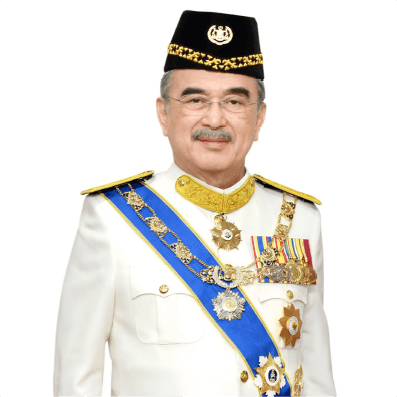
THE PRESIDENT'S PATH: DUTY AND DEVOTION
25 YEARS OF DMDI ON THE WORLD STAGE
Nurturing Brotherhood,
Weaving Civilization
Twenty-five years is not a short time. In that span, the Malay World of the Islamic World (DMDI) has transformed into a big knot that knits together brotherhood, binds history, and at the same time becomes a witness to how God's destiny guides the journey of the people amidst joy and sorrow.
With great gratitude, DMDI President Tuan Yang Atas Tun Seri Setia Dr Mohd Ali bin Mohd Rustam said that until now, this organization still stands tall, is still able to hold conventions every year, and is still a big home for the Malay-Islamic people from 23 countries. "Many more countries want to take part, God willing, we will come and establish it," he said when receiving DMDI Magazine at the Melaka Palace.
The long journey not only contained meetings and trials, but was also full of touching stories. One of them was when DMDI was present in the midst of a big wound for the people: the 2004 Asian tsunami. The giant wave that swept from Aceh to Sri Lanka left deep wounds that were not easily healed. Hundreds of thousands of lives were lost instantly. "That incident was very painful. We never thought that so many people would die," he recalled with teary eyes.
He himself went straight to Aceh, to Sri Lanka, witnessed the ruins and tears. In Malaysia, Kedah also felt the tsunami vibrations. But amidst the destruction, solidarity was born. DMDI together with the Malacca State Government came down to provide assistance, strengthening brotherhood in the rubble of the disaster.
In Aceh, Karya Melaka and DMDI established the Aceh Tsunami Orphans' Home with a donation of RM 700 thousand, which is still well maintained to this day. The building was built on waqf land from Pak Lajwardi Aceh.
From there a big initiative was born: DMDI bought 6 hectares of land in Sri Lanka, specifically in Serbia. Initially, the land was intended to build a Tsunami village. However, plans changed, three hectares were transferred to a private hospital to establish a welfare hospital.
Now, the hospital is operational, serving the community, assisted by the Sri Lankan government. The remaining three hectares are still empty, with plans to exchange them for a new six hectare land on the edge of the inland sea. Meanwhile, another plot of land has been intended for an educational institution.
It doesn't stop there, DMDI also helps provide fishing boats for people in Sri Lanka. A small business, but with big meaning: giving them the opportunity to make a fortune with their own hands. DMDI's historical journey then led the President to follow old footsteps in Indonesia. In Jakarta, he found streets with the names of Malay heroes: Hang Tuah, Hang Jebat, Hang Nadim, Hang Lekiu. In Riau, he saw the Lancang Kuning, a ship that had only been known through poetry.

In Siak Sri Indrapura, he attended the inauguration of the old palace left by the King of Riau. Heavy rain poured down, as if nature was welcoming the arrival of a dignitary. "They say, when dignitaries come, there are always extraordinary signs," he said with a smile. In Bengkalis-Riau, DMDI helped build houses for the Muslim community. "New Brother's House" Center for Converting to Islam in Jangjang Village, Bantan District, Bengkalis Regency. At every step, charity and history combine, seeming to confirm that Melaka and Indonesia are tied by a common thread that goes back centuries.
In Palembang, he climbed Siguntang Mahamiru Hill, a place included in Malay history. "I used to think it was as high as Mount Ledang, but apparently it's lower," he said. But behind its simplicity, the hill holds meaning—traces of Malay princesses, stories of kings, and witnesses to old treaties that link the history of the two nations.

From Padang, DMDI provided financial assistance to the collapsed Siti Nurbaya Elementary School around RM 300,000. There too, cultural traces are re-woven through plate dances and Minangkabau traditions which are displayed in Indonesian festivals. For Mr. President, one event that was no less impressive was establishing a learning center for the Chinese community who converted to Islam. With funds of around RM 300,000 at that time—which is now worth more than one billion rupiah—a meeting center was built, which is still a study and friendship space.
In Jakarta, DMDI Indonesia managed to buy an old house in Kampung Manila. Initially it was about to be sold, but then it was used as a study center. Since then, the house has become a symbol of Malay–Islamic unity in the capital. The Adoptive Home and Adoptive Village initiatives are also running in Medan and Jakarta. Every place becomes a node of friendship, strengthening the sense of togetherness.

From the air, he had the opportunity to see Adam’s Peak, which is believed by the local community to be the place where Prophet Adam first descended to earth—a spiritual symbol that gave profound meaning to the journey. Beyond Asia, DMDI also extended its steps to South America. There, the President met members of the Malay and Indonesian communities who had long been living abroad. He visited their graves, reflecting on how the Malay–Islamic diaspora had taken root far from home in foreign lands.
In Aceh, he witnessed two faces of history. Before the tsunami, Aceh was still engulfed in conflict. Armed soldiers filled the streets, rifles raised at guard posts. Yet after the tsunami, the atmosphere changed. Peace gradually emerged, and wounds were healed through brotherhood.
DMDI was present in Aceh not only with humanitarian aid, but also with cultural programs. The Festival Gendang Nusantara was held, featuring the Saman dance, Tari Piring, traditional music, and Malay cuisine. In the rain, the drums were beaten, the dances were performed, and smiles blossomed. From Aceh and Padang to Melaka, arts and culture became a bridge that drew hearts closer together.
“We use culture—music, dance, food—to strengthen relationships,” he said. For DMDI, culture is not merely entertainment, but a universal language of brotherhood.
From Jambi to West Sumatra, he met with many prominent figures. Some requested DMDI’s support in advancing the palm oil sector, while others invited collaboration in pioneering joint programs. All of this demonstrates that DMDI is seen not only as a cultural organization, but also as a strategic network for the ummah.
In every place visited, there were always shared historical ties. Street names, old palaces, heroes’ graves, and folk songs stand as evidence that the Malay–Islamic bond has never been broken. From Lancang Kuning in Riau to Bukit Siguntang in Palembang, from Adam’s Peak in Sri Lanka to Kampung Manila in Jakarta, each has become a point of light in DMDI’s 25-year journey.
The common thread is charity and silaturahim (bonds of fellowship). Charity that manifests in hospitals, schools, foster homes, fishing boats, and centers of religious learning. Fellowship that is strengthened through cultural festivals, conventions, and inter-state visits.
“We are creatures who cannot resist destiny,” he said. “But we can choose to unite, to help one another, and to preserve brotherhood.” This is the philosophy that keeps DMDI relevant to this day.
Now, after twenty-five years, DMDI is no longer merely an organization. It has become a current of history that continues to carry forward the Malay–Islamic heritage, bringing hope and affirming that wherever Malays may be—from Sri Lanka to South America, from Melaka to Jakarta—there is one bond that will never be broken: the eternal brotherhood of the Malay–Islamic world.

Across the Archipelago: From Mount Daik to Makati Mosque
DMDI’s journey also brought its steps to Mount Daik Lingga in the Riau Archipelago, a name often sung in old Malay verses: “Gunung Daik bercabang tiga” (Mount Daik with its three peaks). The place is not merely a mountain, but a symbol of the grandeur of Malay history. The President set foot there, feeling the ancient resonance recorded in classical chronicles.
From there, the journey extended to Cambodia, where the Malay community continues to preserve its identity. In the land of Angkor, he was captivated to see how many Malays still uphold their culture and religion, despite living as a minority. “Everyone was excited, climbing up together to see the uniquely shaped temple,” he recalled with admiration. So many people climbed onto the platform that it eventually collapsed, he remembered.
During the establishment of DMDI in Timor-Leste, the special aircraft carrying the delegation made a stopover at Surabaya Airport. However, a minor incident occurred when one of the passengers disembarked and smoked in a restricted area. As a result, he was detained by airport security authorities.
In Cambodia, the sense of togetherness felt warm and profound. Malays who had once been marginalized found renewed spirit through DMDI’s presence. The President emphasized that DMDI’s presence was not merely a visit, but an affirmation that they are part of a greater family whose bonds have never been severed.
From Cambodia, the journey continued to the Philippines. In Makati, he visited a mosque that now stands magnificently after renovation. “The mosque used to be modest; now it is beautiful,” he said. He had the opportunity to meet the former imam once again, although some have since passed away.
The Philippines also holds tense stories. When visiting the southern region, he had to travel in a bulletproof vehicle. The journey took hours, filled with caution, as armed conflict was still raging. “This is not something to be taken lightly,” he recalled.
There was even a humorous yet tense incident when a friend brought a guest to the Jakarta Convention in 2019. The guest was suspected of being a member of an armed liberation group from the Philippines. That night, Indonesian authorities came to investigate. “His face resembled someone on the wanted list, though he was not,” he recounted with a soft laugh.

All these experiences demonstrate the vast network of DMDI. From the Riau Islands to Cambodia, from the Philippines to Jakarta, each step was filled with surprises and lessons.
In Lombok, he once again saw Malay traces within the Sasak community. An old mosque that was once modest now stands beautifully after renovation. Every visit left the impression that DMDI is present not merely as a cultural organization, but as a shelter of brotherhood for anyone who holds firmly to Malay–Islamic identity.
The President often mentions that all of this is a “great endeavor” born from small but consistent intentions. Not every intention becomes reality; some are delayed, some change direction. Yet every effort leaves its mark.
From these stories, it is evident that being President of DMDI is not merely a title. It is a journey filled with risks, sacrifices, even dangers. Yet behind it all lies great meaning: representing the Malay voice on the world stage, fostering international communication, and carrying the nation’s name into global engagement. “Sometimes we face challenging matters, some frightening, some amusing,” he said. “But all of it shows how important unity is, how precious brotherhood truly is.”
Leadership and Dedication
In the President’s view, the core of DMDI’s 25-year journey is committed leadership. “We see that those who are truly sincere are active; they continue to organize programs. They do not merely wait, but they move,” he said.
In Indonesia, that spirit is clearly visible. From dakwah programs, cultural activities, to annual conventions that are always well attended. DMDI there does not only discuss grand matters but also nurtures bonds of fellowship among members.
One important step was making the Malay language the official language of the convention. Although in Indonesia it is called Bahasa Indonesia, DMDI wishes to preserve the term “Bahasa Melayu” so that the name is not lost. Online Malay language classes have now begun, enabling the younger generation worldwide to learn it. “This language is the soul of the nation. If the language disappears, identity disappears,” he said. That is why language has become one of DMDI’s primary leadership focuses.
Dunia Melayu Dunia Islam (DMDI) Western Australia Branch was established as a strategic platform to strengthen brotherhood and facilitate various social, cultural, economic, and educational activities among Malay and Muslim communities in the region. The establishment of this branch not only provides a unifying space for the Malay diaspora from countries such as Malaysia, Indonesia, Singapore, Brunei, and Southern Thailand, but also serves as a bridge for international cooperation that preserves Malay–Islamic heritage in the Australasia region while fostering positive integration with the local community.

Cultural programs continue to be actively promoted. Recently, for example, a traditional gasing (spinning top) competition was organized—an almost forgotten Malay tradition. Through such small initiatives, DMDI seeks to revive cultural heritage amid globalization.
Support also comes from prominent figures. Mr. Prabowo, for instance, once contributed a van for DMDI activities. Mr. Jokowi himself inaugurated the Melaka Gallery in Jakarta, a symbol of the bond between two kindred nations.
“But the most extraordinary of all is Mr. Said,” he remarked. This figure is regarded as one of the key personalities who propelled DMDI to its grassroots level. His leadership inspired many, even leading to a special book written about his journey.
In leadership, DMDI engages not only with the general public but also with officials and national leaders. Regents, mayors, and even ministers have been directly involved. From Malaysia to Thailand, from Indonesia to Singapore, DMDI continually encounters new faces carrying the same spirit.
All of this shows that DMDI is a collective leadership network. It does not belong to one person, but to the entire Malay–Islamic community that seeks to safeguard a shared heritage. “I see that leadership is not about position. It is about spirit. About perseverance in continuing the struggle, even when facing challenges,” he said.
Not many people know that the initial idea behind Dunia Melayu Dunia Islam (DMDI) arose from a simple concern: Malays are scattered across the world, yet they lacked a shared platform.
The Initial Idea: Why DMDI Was Established
“Malays are numerous,” the President said. “But they do not meet; there is no organization, no gathering.” Thus was born a great idea: to establish a cross-border organization that could bring together kindred nations every year.
From there, DMDI was born. From the very first day, its principle was clear: at the very least, there must be an annual convention. This yearly gathering serves as the binding thread. Even if only to exchange greetings or become acquainted, it is enough to weave fellowship.
The President always emphasizes that wherever we go in the world, with DMDI, we will always have friends to greet and homes to visit. From there, the sense of kinship becomes real, not merely words.
The initial idea was also supported by many prominent figures. From Thailand, a former Speaker of Parliament who still serves in the House. From Sri Lanka, the then Minister of Justice, Gafur. From Malaysia, political leaders and religious scholars who recognized the need for a larger umbrella. All united in purpose: the Malay–Islamic world must have its own home on the global stage.
There were also young figures who later became ministers, even party presidents. Some were formerly lawyers, others entrepreneurs, and others community leaders. They saw DMDI as a platform to expand influence—but more than that, as a vehicle to serve the ummah.
From the beginning, DMDI focused on three main areas: education, brotherhood and culture, and economy. First is education. Malays must be determined to pursue knowledge. Through DMDI’s network, students can be sent to study in Malaysia, Indonesia, Singapore, India, Thailand, Europe, and the Middle East. Education is regarded as the key to ensuring that Malay–Islamic society does not fall behind.

Second is brotherhood and culture. The Malay language is the official language of conventions. Cultural activities are revived—gasing competitions, saman dance, martial arts, and the Melaka cultural gallery abroad—manifesting how culture is preserved as a collective identity.
Third is the economy. “I hope from these meetings, entrepreneurs are born, merchants become prosperous, and success is achieved,” he said. Thus, the Economic Bureau was formed. Some are just beginning in business, some are seeking partners, others are already successful millionaires. All sit together as equals, learning from one another.
Even those whose businesses were still small were given a place. “Mr. Mohamad, who was struggling and not yet wealthy, joined the economic bureau. He learned to trade and to build networks. Little by little, over time, he became a great merchant.”
In this way, DMDI not only preserves history but also opens the future—a future in which Malay–Islamic society is not only remembered, but respected for its knowledge, culture, and economy. “That is why DMDI was established,” the President concluded. “So that Malays around the world have a home. A family. A shared future.”
Malay Merchants: From Conversation to Commitment
In every DMDI gathering, the faces of merchants are ever present, coloring the atmosphere with entrepreneurial spirit. Some are well established, others are just beginning their journey.
One notable figure is Dato’ Joyah, Head of DMDI Merchants. He is an entrepreneur who has long expanded his business and has never hesitated to support DMDI programs. When requested, he readily contributes RM5,000 or even RM10,000. “Talk is easy; discussion is easy,” as people know him.
There is also Datin Seri Azreen, who manages the DMDI Economic Bureau. She pays special attention to young entrepreneurs who are just starting out. Many of them do not yet have much capital, are still learning the intricacies of business, and are searching for partners. DMDI opens its doors widely to all, with one main condition: the spirit to build the economy of their community and region.
This is the beauty of DMDI. Large merchants and small entrepreneurs sit as equals. Those with capital may help; those without are given space to learn. All are given opportunities to grow.
From these meetings, various new ideas are also born. Some propose producing sharia-compliant watches, others launch global merchant membership cards, and some even dream of publishing an international trade magazine. The principle is simple: whoever has an idea, may pursue it. DMDI becomes a space for the flourishing of inspiration.

 In financial matters, DMDI maintains a clear line. The organization is not a company, not a cooperative, and not a conglomerate. It is merely a platform for gathering, not a place to reap profit.
DMDI does not impose taxes nor claim a share of members’ businesses. Only one condition is emphasized: when there is profit, do not forget zakat. Zakat is not for the organization, but for one’s respective state. Let the religious authorities manage it. In this way, business remains clean, brotherhood untainted, and the organization free from financial burdens.
This is the face of Malay–Islamic economics within DMDI. It is not merely about trading for oneself, but trading with heart. If successful, give thanks. If blessed with abundance, give charity. If not, it does not matter. What matters is never to stop striving.
The Economy as the Pillar of Malay Civilization
Malay–Islamic society cannot uphold civilization without strong economic foundations as its supporting pillar. Throughout the history of world civilizations, we learn that a nation can endure, grow, and earn respect when its culture and civilization are supported by strong power. Likewise with Malay culture. For it to stand firm, there must be strong pillars, and one of the most important pillars is economic strength.
Especially when that economy is built collectively by kindred nations inhabiting the Malay world. In this context, economic resurgence is not merely about material gain, but also about defending dignity and identity.
In the current economic climate, unity is essential to share ideas, proposals, and initiatives framed within a collective spirit. Great civilizations are not born from weak and impoverished nations, but from those who are capable and stand on their own feet. Therefore, the economic pillars of the Malay world must be firmly and cohesively established.
When the Malay economic foundation stands strong, it will weave stronger solidarity and shape a shared vision to elevate the dignity of the nation. Thus, Malays can stand equally among other nations of the world.

 Togetherness, fellowship, and networking form essential foundations in building synergy among kindred Malay nations. Through such unity, economic strength can be reinforced, civilization preserved, and Malay dignity continually elevated.
In every convention, merchants speak not only of profit. They discuss cross-border promotion, opportunities in Indonesia, prospects in Malaysia, and even markets beyond Asia. All are united by one spirit: building a strong global Malay–Islamic economy.
Some arrive bringing projects; others come merely to seek friendship. Some contribute generously; others simply purchase tickets to participate. Yet all are welcomed with open arms. “If you succeed, we rejoice. If you fail, we remain friends,” the President said.
In the end, DMDI becomes a great space where friendship is valued above profit, and brotherhood above capital. That is why, although many businesses are born from DMDI gatherings, the organization remains a house of fellowship—not a corporation.