
DMDI WEST SUMATRA
GUARDING DIGNITY
FROM THE HEART OF
MINANGKABAU

Amid the rolling hills of West Sumatra, between the whispers of wind flowing through the valleys and drifting into the old surau, there still burns a flame of history that has never truly gone out. This land once pulsed as a center of the intellectual and spiritual awakening of the Indonesian archipelago.
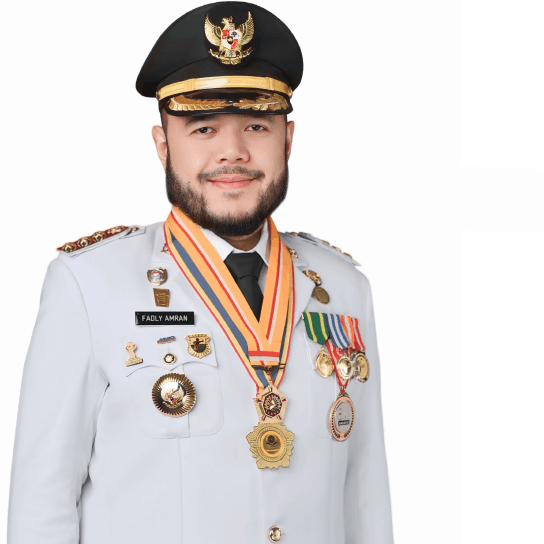
Fadly Amran, a Minangkabau man bearing the traditional title Datuak Paduko Malano, does not stand merely as a mayor. He arrives carrying a mission far deeper than the routine of administrative governance: to revive the pulse of civilization from the very heart of this land. It is a determination born not from the ambition of power, but from a profound love for the soil of his ancestors.
The Chairman of Dunia Melayu Dunia Islam (DMDI) of West Sumatra Province pursued his education far from his homeland, at Shoreline Community College and Seattle University in the United States. Yet he returned not merely with academic degrees, but with a conscious longing—an understanding that a great nation is one that honors the roots and dignity of its culture.


In 2009, he returned to Padang. Not to rest, but to plunge directly into the current of youth movements. He began by establishing HIPMI Kota Padang, an organization for young entrepreneurs that at the time was still searching for its direction. Through hard work and clear vision, he transformed HIPMI into more than just an organization: it became a home for ideas, a network for economic struggle, and a place where future national leaders could be nurtured.
From HIPMI, he moved on to KNPI. He became Chairman of KNPI Kota Padang, and later of KNPI West Sumatra. These positions were never used to celebrate status, but to awaken awareness—that youth are not merely complements to the nation, but the drivers of its history.
Yet West Sumatra itself is like a mother watching her children. This land once gave birth to towering figures: Buya Hamka, Tan Malaka, and H. Agus Salim. The philosophy Adat Basandi Syarak, Syarak Basandi Kitabullah echoes like a sacred mantra—recited solemnly, displayed on office walls, yet too often hollow in practice. It stands as a noble slogan, but one that has sometimes lost its living breath.
Entering Government
A recipient of the international Anugerah Temenggong Tun Hassan DMDI, Fadly Amran understands well that building a city cannot rely merely on projects and programs. A city is like a body, and a body can only be healthy when its soul is alive. Thus what he seeks is not simply to polish sidewalks or beautify parks, but to restore the city’s spirit so that it may regain its dignity.
For him, leadership means the courage to be different. The courage to be firm when others are permissive. The courage to be honest amid a culture of compromise. And the courage to begin initiatives that may not be immediately popular, yet carry profound meaning for the long term. He sees that today’s bureaucracy has lost much of its spirit. Civil servants are often exhausted by administrative routines, too cautious of political shadows, and too often forget that their primary duty is to serve— not to be served.

Fadly Amran envisions a bureaucratic system that is not only efficient, but also grounded in values. Civil servants should not simply arrive at eight and leave at four, but carry a genuine spirit of service and an integrity that cannot be negotiated.
He calls upon the state apparatus to become individuals of character. “Just as the mamak in the village once served as a role model, just as the guru mengaji once stood as a guardian of moral life, government must become a servant that is present not only with its hands, but also with its heart,” Fadly Amran says.
In every step he takes, he is deeply aware that leadership is a spiritual practice. He does not wish to hold office merely to exercise power, but to repair what is broken. Not to display authority, but to carry the burden of responsibility.
Fadly Amran does not speak in empty idealism. He understands that change requires a system. He builds teams, invites experts, and formulates strategies. Yet beyond all of that, he begins with himself: arriving earlier, leaving later, and accepting full responsibility.
He understands well that the most dangerous disease of bureaucracy is the phrase, “that’s just the way it is.” A permissive mentality that treats deviation as normal. So he arrives with a different stance: “If something is wrong, we fix it. If there is dishonesty, we clean it up.”
He once personally experienced how a well-executed project could still be exploited. After everything had been completed, he was asked for “pitih” (money). It was a harsh slap of reality—that even good intentions could be viewed with suspicion within a broken system. Thus, he resolved to cut that chain.
“For me, physical development can be carried out by many people. But the development of values—that is a far heavier task, quieter, and far riskier. Yet that is where its true nobility lies,” explained Fadly Amran.
He often says: “If the system is clean and the people within it work professionally, the bureaucracy will run on its own, without the need for constant supervision.” That is his great dream: a city that does not depend on a single person, but moves forward on the foundation of values and systems.
 Practical politics has damaged many pillars of government. The positions of teachers, school principals, and even civil servants often depend on whom they meet, rather than what they are capable of. Therefore, he wants to cleanse those spaces.
Like a CEO who arrives at a dying company, he does not rely solely on spirit. He relies on a map. Strategy. And most importantly: people. Because for him, every transformation begins with the quality of human resources.
He believes that human resources are a long-term investment. Therefore, he focuses on nurturing, not merely replacing. Giving civil servants room to grow, not judging them solely by numbers and reports.
From Padang Awakening
West Sumatra
“The revival of West Sumatra is not merely about roads or buildings, but about dignity. It is about how the people regain trust in their leaders, and how leaders once again nurture the hopes of their people,” said Fadly Amran.
There are still surau, there are still wise mamak, and there are still young people restless from witnessing conditions that have remained unchanged for too long. These are the people he wants to bring together again.
Because a civilization is born from interconnected nodes.
He is not opposed to modernity. But he wants a West Sumatra that advances with roots, not one that grows like a tree uprooted and replanted in foreign soil. He wants progress that flows from local values, from the roots of its own culture.
“I want an honest city. A place where entrepreneurs are not afraid to invest because they fear extortion. A place where young people can dream because they feel supported. And a place where ordinary citizens feel heard, not merely watched when election season arrives,” he said.
Fadly Amran does not speak of revolution. He speaks of civilization. Of rebuilding West Sumatra as an epicenter of ideas, ethics, and intellectual life—just as it once pulsed during its golden age. He knows the path will not be easy. But he believes that through collective effort, change can happen. He does not ask for a red carpet, only the opportunity to prove that this dream is not a utopia.
And Fadly Amran will begin his efforts once again from the epicenter of West Sumatra, the City of Padang, which this year celebrates its 356th anniversary. There are nine flagship programs being carried forward with 40 activations.
Most of these programs relate to the welfare of the wider community, such as Free BPJS Health coverage, which has already been enjoyed by nearly 30,000 residents of Padang City; Free School Uniforms and LKS (Student Worksheets) that have benefited more than 12,000 students; Smart Surau programs across 11 districts; UMKM Moving Up a Class; Successful Cooperatives; Dubalang Kota, and many others.
Fadly Amran wants to demonstrate that leadership is service. To lead is to provide opportunities for society to grow, develop, and become empowered. For him, being a leader is not about pleasing everyone, but about saving the direction. It is about steering the ship back to the right harbor, even if it means facing strong and relentless currents.

He does not ask to be praised. He only hopes that someday his grandchildren will be able to say: “Back then, in that time, there was someone who truly tried. Someone who believed that West Sumatra could once again become a beacon.”
And if today we all take part in the journey—contributing our thoughts, safeguarding values, and upholding honesty—then that flame will shine brightly once more. The Ranah Minang will not only come alive again, but will rise as the true epicenter of the civilization of the Indonesian archipelago.