
LEADERS & FIGURES
“Between Surahs and the Dawn:
An Unshakable Anchor”
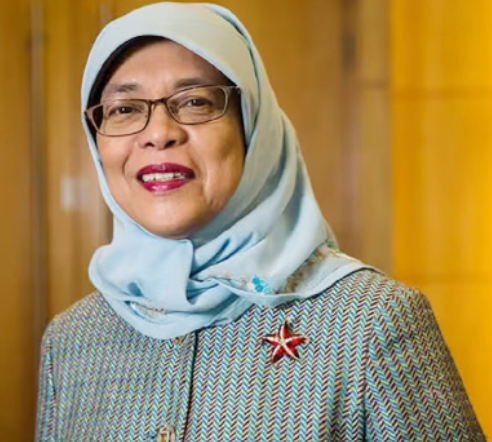
Halimah Yacob - 8th President of Singapore.

Every morning, when dawn has not yet fully broken, I welcome the day with something greater than the sunlight—I welcome it with the words of God. Surah Yasin and Surah Ar-Rahman become the opening steps of my day, like lamps shining along the corridors of a life filled with challenges. In the quiet moments after Subuh, I find a peace that cannot be measured by the world.
Night, too, I do not simply let pass. Before drifting into sleep, I weave again the threads of remembrance through Surah Al-Waqi’ah and Surah Muhammad. Like loyal companions embracing me at the end of the day, those verses guard my soul from anxiety and restlessness. They are not merely recitations, but breath that gives life to my inner being.
I know that the path toward serenity is not always straight and open. Many people desire results as quickly as lightning striking the sky. But I believe in the flow of water—slow, patient, yet certain in carving stone. And so each day, even if only one surah, I choose to remain faithful. Istiqamah is the key, not speed.
My principles in life are like the roots of an old tree planted deep into the earth. I do not change easily simply because the winds shift direction. In a world that sways easily with opinion and waves of popularity, I believe in the strength of conviction. For if we do not hold our own principles, the principles of others will replace them—and that is where the loss of identity begins.
From my mother, I learned the true meaning of hard work. In a small one-room house, we lived with the simplest means. Even clean water had to be contested with the residents below us—if they opened the tap first, we would run out. So my mother woke at four in the morning, not to complain, but to fill the water containers for our family.
The image of my mother in the early dawn still lives in my mind today. That strong woman planted within me a value that never fades: that success is not merely the result of luck, but the fruit of tireless effort and unending prayer. From that one-room house, dreams were born that would later become reality.
Even though my path has now stretched far—carrying responsibilities across the nation and beyond—I have never forgotten the roots from which I grew. The recitation of the Qur’an travels with me wherever I go. It is like a compass in the wilderness, and a blanket in the coldness of the world. It does not only calm me, but strengthens me.
And perhaps, in this ever-changing world, the only thing we can truly hold onto is faith. Faith in God, in principles, and in the path of life we honestly choose. Because in the end, life is not about who moves the fastest, but who remains faithful to the path—slowly yet surely—toward the light.
“Diligence Is
the Way Home”
My mother was not merely a resilient woman—she was the embodiment of perseverance that never faded. In a cramped house with only one room, she never allowed limitations to dampen her spirit. Every dawn, before the residents below turned on the tap and drained the water from the tank, she was already there, patiently collecting every drop of sustenance. That water was not only for drinking—it was for life itself: for cooking, washing, and sustaining the family.
Her days were filled not only with household duties but also with a quiet craft she mastered: crochet. Her hands were never idle. The crocheted fabrics she made decorated tables, covered chairs, becoming silent heirlooms that I still keep today. Hundreds of pieces—not for sale, but as proof to herself that life must be filled with purpose. That as long as breath remains, one should never sit idly with folded hands.
Yet time eventually asks its price. Several years before her passing, dementia slowly crept in, erasing memories and the skills that once defined her. The hands that once skillfully crocheted could no longer remember the threads and needles. And in that moment I realized even more clearly that daily practice is not merely exercise for the body, but nourishment for the soul. We fill our days with meaning so that when loss arrives, we do not feel empty.
From her I inherited the spirit to continue working, to continue giving, without weariness. I am not someone who can sit still. Even when entrusted with the responsibility of being President, I did not simply remain within the walls of a glass palace. I walked, visited communities, greeted people, supported them, and raised funds for those in need.
For me, power is not an ornament. It is a tool. And a tool is only meaningful when used to improve lives, not to display prestige. It is not easy to remain upright within a system full of crossroads and temptations. Many stumble under the weight of position and forget their purpose. But I believe that when someone is entrusted with responsibility, that trust no longer belongs to them alone. It belongs to society, to faith, and to God. And if we waste it, we betray not only trust—but the very nature of our humanity.

My thoughts often wander to broader matters—about nations, about economies, about the Muslim world. I observe Indonesia—with all its resources and potential—moving forward. Under President Jokowi, the country has been able to attract investment, strengthen its economy, and give hope to domestic companies. It is no longer merely selling raw resources, but adding value—so that what is exported is not only the earth’s contents, but also the product of human intellect.
In the Malay-Islamic world, we possess extraordinary potential—oil, gas, palm oil, fertile land, and a young and energetic population. Yet we must be wise. Resources alone will not elevate us if we do not know how to add value to them. Many developing nations fall into the same trap: rich in resources, poor in processing. The world does not value what is taken raw—it values what is refined with knowledge and vision.
I believe the road ahead is not only about capital and technology. It is about principles and perseverance. It is about building, not burning. And in a world that continues to change, perhaps the most valuable thing is to remain human—someone who remembers where they came from, understands their purpose on this earth, and completes life’s journey leaving behind a meaningful trace.
A Story
in the Drizzle
of Light
In the heart of Singapore, once dusty and crowded, in a narrow lane called Queen Street, a baby girl was born sixty-three years ago on August 23. Her name was Halimah Yacob, the youngest daughter of a modest family living in a tiny one-room flat. There the first rhythm of her life began—amid the breath of struggle, the aroma of nasi padang, and the unconditional love of a mother.
Her father passed away too soon—leaving this world when Halimah was only eight years old. The grief could not linger long, because life demanded that they keep moving. Her mother, a resilient woman with skillful hands and a generous heart, pushed her nasi padang cart through the city streets. From that cart came their livelihood—five children who had to be fed, educated, and raised with dignity.
Little Halimah grew up among the smoke of the kitchen and the noise of the marketplace. She was not only a child, but also her mother’s right hand—cleaning the stall, washing utensils, and arranging the fragile plastic tables that held countless stories. There she learned her first lessons about hard work—not from books, but from life itself.
 Yet God planted a star within her soul—perseverance and an unyielding spirit. With that determination, Halimah was accepted into prestigious schools: Chinese Girls’ School for secondary education and later Tanjong Katong Girls’ School for high school. Among the dominant Chinese student population, she stood as a Malay girl—alone, yet unafraid. Though she often skipped school to help her mother and repeatedly fell behind on tuition payments, Halimah never gave up. She nearly faced expulsion, but destiny still embraced her.
Her perseverance was rewarded when she was accepted into the Faculty of Law at the National University of Singapore, where the nation’s finest young minds pursued knowledge. There she also received a scholarship from the Islamic Religious Council of Singapore, proof that her efforts had not been in vain.
In 1978, Halimah entered the workforce by joining the National Trades Union Congress (NTUC). She began at the grassroots level as an ordinary member, listening to the concerns of workers and learning from the struggles they faced. Three decades passed, and she rose to become Deputy Secretary-General of NTUC—respected and loved not because of her title, but because her heart remained unchanged: loyal to the working class.
In 2001, history knocked on her door. Prime Minister Goh Chok Tong invited her to enter politics. Halimah agreed—not out of ambition, but from the belief that her voice could become a bridge for those who had long gone unheard. She became a Member of Parliament for Jurong, making history as the first Malay woman to sit in Singapore’s Parliament. Later, she would rise to become Speaker of Parliament—a step once unimaginable for the girl from Queen Street.
And when history once again turned toward the Malay community to determine the presidency, Halimah became the only candidate deemed eligible. Not because she was the only one standing, but because she was the one truly worthy to stand there. On Wednesday morning, September 13, 2017, Halimah Yacob took the oath of office as the President of the Republic of Singapore—the first woman to hold the nation’s highest office.
She did not come from a palace, nor from noble lineage, but from the narrow streets of the city and a humble nasi padang cart. From there, she proved that the road to the highest peak can be walked by anyone who carries light within themselves.
A mother of five, a tireless worker, a leader rooted in the soil of the people’s struggles—Halimah binti Yacob is not merely a name. She is a story of hope, resilience, and love that has become history.