
JAMIYAH SINGAPORE
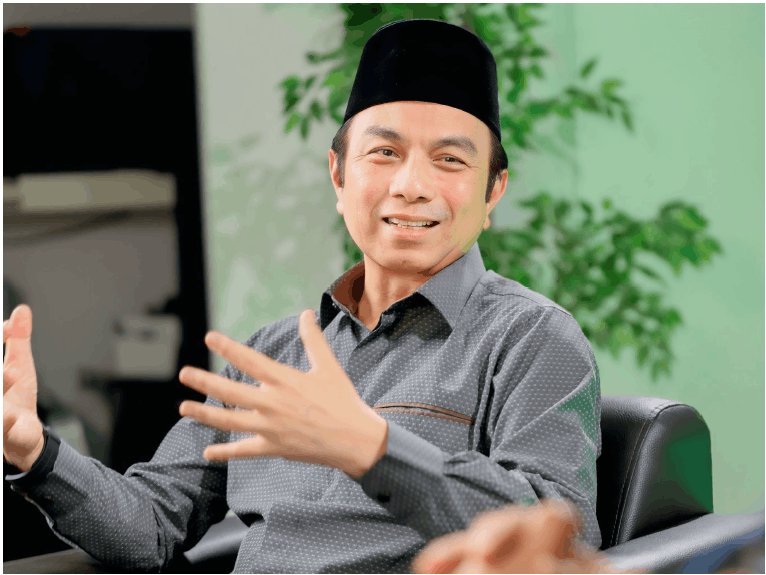
PROF. DATUK DR MOHD HASBI ABU BAKAR
PRESIDENT OF JAMIYAH
THE LANDSCAPE OF MALAY-ISLAMIC CULTURE
FROM THE EARLY DAYS OF JAMIYAH
TO A GLOBAL VISION

Amid the rapid currents of modernisation and globalisation, DMDI together with Jamiyah Singapore views Malay culture not merely as a legacy of the past, but as the living pulse of identity that must be preserved. This culture stands as an embracing canopy, rooted in the noble values of Islam while remaining relevant within the modern landscape. Through education, arts, the creative economy, and spiritual programmes, these joint efforts do not merely safeguard heritage but also strengthen identity, build unity, and open pathways for the Malay-Muslim community to emerge as a dynamic global community—competitive and progressive, yet never detached from its cultural roots and the noble values of its faith.
This was conveyed by the President of Jamiyah Singapore, Prof. Dr Datuk Mohd Hasbi Abubakar, who received the visit of DMDI Magazine at the Jamiyah Singapore office in a warm atmosphere, while recalling the early moments of Jamiyah’s establishment and the period when Datuk Hasbi led the organisation. With carefully measured words and memories still vivid in his mind, he shared valuable perspectives and experiences. The following are excerpts from the interview, divided by the editorial team of DMDI Magazine into two parts.
How do DMDI and Jamiyah Singapore view the position of Malay culture in the current wave of modernisation and globalisation, particularly in Singapore and the states of the Peninsula?
First of all, I would like to express my appreciation to Datuk Said Aldi Al Idrus, Chairman of DMDI Indonesia, who has given me the opportunity for this interview. The 23rd DMDI Convention will be hosted by DMDI Indonesia from 23–26 October 2025. My congratulations to DMDI Indonesia, especially to Datuk Said Aldi Alidros.
Malay culture is the pulse of our identity. In Singapore, we view Malay culture not as a historical relic but as a source of values and identity that must continue to be preserved. Through strategic collaboration between DMDI and Jamiyah Singapore, we strive to keep this heritage relevant. For example, by promoting Malay arts and dance through regional collaborative workshops, as well as various cultural events and festivals.

In Datuk’s view, what is the greatest challenge faced by Malay culture in maintaining its identity within a multicultural society such as Singapore?
The main challenge is the rapid assimilation of global culture, particularly the influence of Western culture through language, media, and technology. English has become the intermediary language for intercultural and international communication. However, the use of this language should not lead to the neglect or overshadowing of the invaluable values of our mother tongue and cultural heritage.
DMDI and Jamiyah Singapore regard this as an important call to intensify efforts in Malay cultural education and to nurture identity among the younger Malay generation through various carefully designed cultural initiatives.
To what extent does Islam play a role in strengthening and enriching the expression of Malay culture today?
Islam is the pillar of Malay culture. Our culture is incomplete without Islamic values that shape speech, customs, and ways of life. Within DMDI and Jamiyah Singapore, we emphasise the values of syarak that are harmoniously integrated with tradition, making Malay culture not only unique but also rich with wisdom and noble etiquette.
How do DMDI and Jamiyah Singapore see the opportunities for Malay culture to remain relevant and contribute to the social, economic, and spiritual landscape of society?
The opportunities are very wide, particularly in the fields of arts, the creative economy, and inclusive spiritual approaches. The programmes implemented are not merely aimed at preserving Malay-Islamic culture and heritage but also play a role in strengthening social unity and building identity in facing the challenges of the modern era.
Among the initiatives carried out are cultural performances such as traditional dances and Malay musical expressions that celebrate the beauty of the nation’s artistic heritage.

In the socio-religious dimension, DMDI and Jamiyah Singapore organise various programmes such as Quran recitation events, Maulid Nabi celebrations, regional da’wah activities, and humanitarian missions. All these efforts complement one another and reflect a shared commitment to strengthening the brotherhood of the ummah under the banner of Dunia Melayu Dunia Islam.
Are there specific strategies or programmes implemented by DMDI and Jamiyah Singapore to ensure that Malay cultural heritage continues to thrive?
Jamiyah Singapore has established DayaSeni, a new platform aimed at empowering Malay arts, culture, literature, and intellectualism to a higher level. Through cooperation with DMDI, we position Malay arts and literature as part of the human capital development ecosystem, not only in Singapore but also across the region.
In Datuk’s view, how will Malay culture evolve in the next 20–30 years amid rapid technological change and global cultural influences?
Malay culture will continue to evolve alongside global progress. We believe that through the combined strength of the halal economy, Islamic banking, as well as progress in education and professional careers, the Malay community will emerge as a modern global community that remains closely connected to its cultural values and Islamic principles.
In Singapore particularly, the growing number of Malay professionals and graduates reflects a stronger competitiveness in the modern economy.
As a result, the Malay-Muslim community will not only be competitive and dynamic on the international stage but will also be able to maintain its identity and core cultural and religious values in facing the challenges of a globalised world.
How can cooperation between Singapore and the states of the Peninsula strengthen the network of Malay culture so that it continues to serve as a pillar of shared identity within Dunia Melayu Dunia Islam?
We must cultivate the spirit of a single Malay kinship, one that transcends political and geographical boundaries. Cooperation through regional festivals, cultural and educational exchange programmes, and networks of Malay-Islamic organisations in the Peninsula states will ensure that this culture continues to live, grow, and be respected as a pillar of civilisation.
Alhamdulillah, today the President of DMDI, TYT Tun Seri Setia Dr Mohd Ali Mohd Rustam, has successfully established 23 Secretariats in 23 countries. This network of secretariats further strengthens Malay culture.
 THE STRATEGIC AGENDA OF DMDI
In Datuk’s view, what is the most urgent strategic agenda for DMDI to emerge as a respected organisation in the Asian region?
In my view, the most urgent strategic agenda for DMDI is human capital development. We must empower the younger generation through education, technical training, micro-entrepreneurship, and scholarship networks.
At the same time, DMDI should play an active role in assisting Malay-Muslim communities in the region who are still in need through programmes in education, health, and community development. This approach not only preserves culture but also builds inclusive and effective regional socio-economic strength.
How can DMDI position itself not only as a cultural platform but also as an influential social, economic, and intellectual force at the regional level?
DMDI must move as a multidimensional organisation—from culture to economy, from discourse to action. By combining cultural festivals, intellectual forums, and humanitarian initiatives, we build comprehensive influence—recognised not only as a guardian of heritage but also as a driver of progress.
The foundation for DMDI’s continued progress has indeed been prepared by its President, TYT Tun Seri Setia Dr Mohd Ali Mohd Rustam. When DMDI was established 25 years ago, this visionary leader created various bureaus such as Education, Economy, Da’wah, Socio-Culture, and others.
Should DMDI establish a research centre, think tank, or digital platform to strengthen intellectual networks and policies in the Asian region?
The time has come for DMDI to have its own think tank, similar to the Oxford Centre for Islamic Studies (OCIS), functioning as a centre for research, discourse, and international dialogue.
With the support of experts, academics, and sustainable funding, such a centre could become a landmark of Malay-Islamic thought—producing policy research, building scholarly networks, and serving as a global reference for Malay-Islamic culture and intellectual tradition.
In Datuk’s view, what values must remain the foundation of DMDI so that its influence can continue to expand without sacrificing its Malay-Islamic identity?
There are three core values that must serve as the main foundation. First, Accountability—carrying out entrusted responsibilities with full integrity and transparency, ensuring that every action is guided by ethics, honesty, and justice. Second, Visionary Leadership—formulating wise strategies and long-term planning guided by cultural values and current challenges, for the continuous advancement of the Malay-Muslim community. Third, Commitment to Service—being ready to serve society with strong dedication, sincere intentions, and sustained efforts, so that every initiative delivers a meaningful impact for the ummah and for future generations.
JAMIYAH:
A FLAME
THAT NEVER
FADES


Young Blood in Jamiyah
At the age of ten, Datuk Hasbi came to know Jamiyah not as a distant institution, but as a part of his own family. His father, together with fellow comrades-in-struggle, took over the leadership of Jamiyah in the early 1950s. At that time, they were all in their early forties—still considered “young blood” compared to the leaders of other Islamic organizations who were generally much older.
According to him, before his father was appointed President of Jamiyah, family life was filled with joy: picnics by the seaside almost every weekend, holidays in Malaysia, and various relaxing activities that strengthened their family bond. However, once his father was chosen to lead Jamiyah, all of that came to a halt. The new responsibility demanded sacrifice. Even so, his father never wished to leave the family behind. “He wanted us to come along, to contribute our energy, and to struggle together in the work of Jamiyah,” said Datuk Hasbi.
When Haji Abu Bakar Maidin—his father—took over, Jamiyah was far from being a strong institution. The money left was only SGD 5.65. There was no building yet, except for two floors endowed by King Faisal of Saudi Arabia. “That was when I began to understand the meaning of struggle: an Islamic organization that was almost empty of resources, yet full of the spirit of people who believed,” Datuk Hasbi recalled.
At that time, even though he was still in school, Datuk Hasbi spent almost every week at Jamiyah. His family also helped raise funds, collect donations, organize events—anything that could be done. These activities were not merely voluntary work, but life lessons that instilled the values of sacrifice from a young age.
In truth, he could have chosen not to be involved. “I could have said that it was purely my father’s affair. But because we were used to walking this path together as a family, I was carried along by that current of devotion. From the beginning, we never separated home life from life in Jamiyah—both flowed together in a single bond,” he said. That experience shaped him: witnessing how his father and fellow comrades, despite financial limitations, were able to move something greater than themselves. “Young blood” was not merely a title, but the courage to shoulder responsibility when others chose silence.
 Family Devotion Amid the Trials of the Times
Their family had always been very close. Whatever challenges his father faced in leading Jamiyah, the family was never left aside. “He knew his duties were extremely heavy, but he still wanted us beside him. So family quality time was no longer by the sea or in parks, but in the spaces of Jamiyah—at work desks, at fundraising gatherings. That was how he united devotion and togetherness,” said Datuk Hasbi.
His father believed that if Jamiyah’s work required sacrifice, then that sacrifice should be shared together. They were present not merely as spectators, but as volunteers—collecting donations, arranging programs, accompanying long meetings. “This made us realize that Jamiyah was not just an organization, but a second home that shaped our souls,” he said.
What moved Datuk Hasbi the most was witnessing how his father still managed to keep the family close, even while immersed in immense responsibilities. Weekend recreation turned into “spiritual recreation”: building something together for the community. Those memories remain deeply etched—that their family had once been both witness and participant in the great history of Jamiyah.
The year 1970 became the most severe trial. Singapore and Malaysia had just separated, and immediately the Malay-Muslim community in Singapore became a minority. The sense of loss was real: the support that once existed was suddenly cut off. “Like a tree whose roots were sawn off, our community was forced to stand on new soil,” said Datuk Hasbi.
The government demanded that Singapore build itself independently—and that was reasonable. Yet for minorities, the challenges were layered. Education, economy, culture, even religion—all required internal drivers, because external support was no longer there. It was here that Jamiyah became a field of service, a bridge to close the gaps that opened after the separation.
Datuk Hasbi still remembers the atmosphere of those days. Nights in downtown Singapore, with small shopping centers and modest shops, felt bleak. Many Malay families lived in hardship, searching for space to survive. As a minority, they had to struggle harder—not only to support themselves, but also to ensure that their identity and dignity were not swept away by the tide of modernity.
Thus the task at Jamiyah was no small one. They provided educational spaces, helped poor families, and preserved the continuity of culture and religion. Every cent collected, every hour of effort given—everything was meant to reconnect the pulse of a community that was nearly severed. They also understood that every ethnic group in Singapore was facing its own challenges. Yet as a minority, the effort had to be doubled in order to be recognized, to stand equally, and not to disappear from the map of nations. Jamiyah became the vessel through which that dedication flowed.

His father often reminded them that this struggle was not only for today, but for the grandchildren of tomorrow. If the gap were allowed to widen, future generations might lose their path. Thus every Jamiyah program was not merely a social activity, but a signature in history—certain and enduring—ensuring that Jamiyah would continue to exist, remain capable, and be respected.
Today, when Datuk Hasbi recalls those times, the emotion remains strong. Jamiyah is not merely an institution; it is a family story, a community story, the story of a small people struggling within a young nation. From only SGD 5.65 in hand to becoming a driving force for the community—this is proof that sacrifice, even when it begins within a small family, can blaze into a torch for the community.
Jamiyah: From the Family Kitchen to the Center of Community Service
The clearest childhood memory: when he was only ten years old, Jamiyah—the place where his father had just been appointed president—had only RM5.65 in its savings. There was no meeting room, no facilities. Then his father said, “Let us simply do it at home.” And indeed, that was where everything began.
Datuk Hasbi’s mother prepared whatever food was available. He helped serve it, bringing it to the living room for about fifteen to twenty committee members. Although he was still young, he felt as though he was part of history—sitting beside adults, watching serious faces discussing the future of an organization that was almost empty.
His father’s first message to the committee remains fresh in his memory: “Let us not dream of organizing programs if there is no finance. Our first duty is to generate funds. Find funds, then we can move forward.” Those simple words left a deep mark. From them Datuk Hasbi learned that idealism requires real provisions.
At that time, Singapore still had many villages. The Malay-Muslim community lived scattered in small kampungs, knowing one another well. Almost every week they went from house to house, knocking on doors, introducing Jamiyah, and collecting donations. Some gave a little, some gave more; the most precious was the sincere support.
Because of that support, Jamiyah soon grew. Buildings appeared one after another, programs were carried out one after another. All of it happened not because of the strength of a few individuals, but because the community believed Jamiyah belonged to them. His father always emphasized, “If you want to build an organization, do not speak if there is no money. Funds are the lifeblood of the struggle.”
For forty years, his father led Jamiyah. He gave all his energy, time, and even his family life to ensure the organization survived. The results are clearly visible today: Jamiyah has become a large institution, respected and playing an important role in the development of the Muslim community in Singapore and the world.

Yet every era has its challenges. The needs of the older generation differ from those of the younger generation today. If in the past the focus was on education, mosques, and welfare, today the field is wider—economic development, identity building, and spaces for youth leadership. Their task is not merely to guard the legacy, but to adapt it to the times.
Since Datuk Hasbi took over the leadership in 2012, his determination has been clear: to ensure continuity. He did not want Jamiyah to stop in the hands of the older generation. There must be a new layer—young leaders trained from the beginning and given space to lead—so that Jamiyah would not merely survive, but continue to grow.
Alhamdulillah, today Jamiyah’s ranks are filled with many young people. They learn from experience, they are given opportunities, and Datuk Hasbi believes that one day they will lead better than his own generation. That is the true essence of leadership: not preserving oneself, but preparing successors.
When he recalls his childhood—helping his mother prepare food for Jamiyah meetings at home with funds of only RM5.65—and compares it with the present, “my heart is deeply moved. From a simple dining table, Jamiyah now stands proudly as a center of service for the community. Our duty—mine and everyone’s—is only one: to ensure that this torch never goes out, but continues to shine for generations to come,” he said.
Jamiyah: The Legacy of Scholars, A Platform for the Ummah
Jamiyah is not merely an institution; it is the legacy of a great scholar of the world, Maulana Abdul Aleem Siddique from Meerut, India. In 1932, he established Jamiyah in Singapore as part of his global da‘wah mission. The last forty years of his life were dedicated to traveling around the world, and in every country he visited, he founded Islamic associations as bases for the struggle.
From the hands of a traveling scholar was born a network of Islamic organizations that crossed the boundaries of nations and peoples. Singapore became one of the important nodes. Every gathering he held brought together scholars and local leaders, making Jamiyah from the very beginning not merely a local platform, but a center of international friendship and brotherhood.
That legacy lives on until today. The vision and mission of the founder have never faded, but have been continued generation after generation. From a modest room with only RM5.65 in funds, Jamiyah is now approaching a century in age. The same pulse—da‘wah, education, welfare—continues to beat.
