
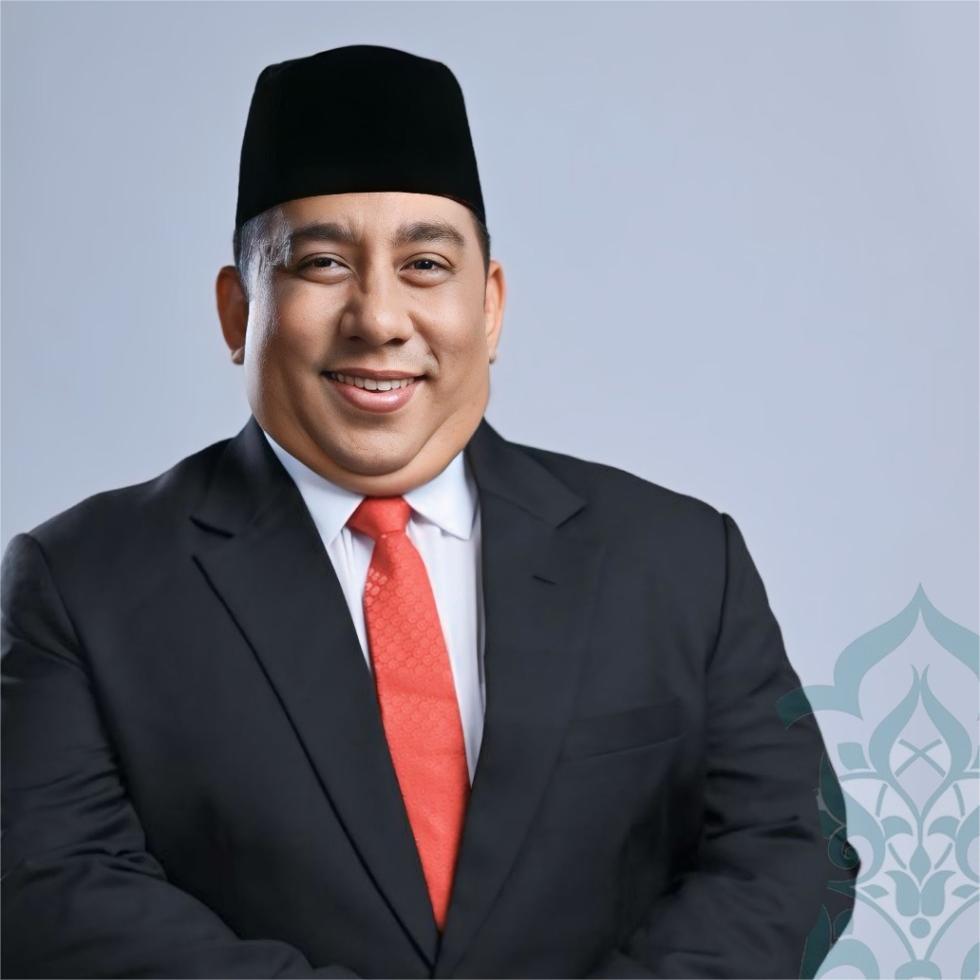
DMDI INDONESIA
DATUK H. SAID ALDI AL IDRUS
Chairman of DMDI Indonesia / President of World Mosque Youth
WEAVING SILATURAHMI,
UPHOLDING THE
MALAY–ISLAMIC CIVILIZATION

Amid the swift currents of an age that often erode values, there emerges a leader who does not merely walk, but runs across the landscape of international silaturahmi: Datuk H. Said Aldi Al Idrus, Chairman of Dunia Melayu Dunia Islam (DMDI) Indonesia. As if possessing an endless reserve of energy drawn from the spring of faith, he crosses the boundaries of time and space—appearing at two, even three meeting forums in a single day, sometimes in two different countries: Indonesia and Malaysia. His steps are not simply visits, but threads of brotherhood woven to strengthen the fabric of the Malay-Islamic community across the world.
For Datuk Said, who has recently been entrusted as President of the World Mosque Youth, silaturahmi is not merely social etiquette, but the very breath of struggle. He believes that from silaturahmi grows the strength of unity, sustenance flows, and the life of a cause is extended. He does not place his hopes in slogans or ceremonies, but in commitments woven through meeting after meeting, in hands that are clasped, and hearts that are touched. The great role entrusted to him is not a burden, but a mandate he embraces firmly, to ensure that the young generation of Muslims become not only witnesses of their time, but also the ones who determine the direction of civilization.

 Leading an organization as large as DMDI, with more than twenty regional administrations extending to regencies and cities throughout Indonesia, is certainly not a light task. DMDI does not only require a chairman, but a visionary—someone who is not merely good, but must also be firm, courageous, and unwavering. Said Aldi understands that progress is never born from hesitant steps. A true leader is not one who fears failure, but one who fears stopping the effort to try.
In many forums, he often reminds audiences with a tone of deep reflection: “The civilization of a nation will only grow great when it is supported by strong power and a resilient economy.” As the former Chairman of Himpunan Pengusaha Muda Indonesia (HIPMI) North Sumatra, he fully understands that the strength of the community is not determined by rhetoric alone, but by economic resilience. From this understanding emerged the idea of Saudagar Melayu DMDI—an institution envisioned as a new pillar in building the economic strength of the Malay community.
For Datuk Said, the economy is not merely a matter of profit and loss, but a tool of struggle to uphold the dignity of the nation. He believes that every small or large enterprise born from the hard work of Malay-Muslim entrepreneurs is part of a civilizational struggle: resisting backwardness, fighting poverty, and at the same time building dignity. Through Saudagar Melayu DMDI, he seeks to create a space where ukhuwah does not remain merely a word, but transforms into a collective force capable of upholding civilization.
This appointment becomes a continuation of his long journey in strengthening brotherhood and the shared economy of the Malay world. If through DMDI he upholds the Malay-Islamic civilization through networks of merchants and cross-national silaturahmi, then through World Mosque Youth he now moves even further—bringing the spirit of the mosque as the center of the Muslim community’s movement onto the global stage. These two great roles are not a burden, but a trust he embraces firmly, to ensure that the young generation of Muslims become not merely witnesses of their era, but also the ones who determine the direction of civilization.

 Bringing the World Mosque Youth to the Global Stage
With a burning spirit, Datuk Said Aldi Al Idrus has now officially been entrusted with the mandate as President of the World Mosque Youth for the 2025–2030 period. This significant responsibility was announced following a strategic meeting with Cambodia’s Senior Minister, H.E. Dr. Othman Hassan, in Jakarta. The moment was not merely a formality, but the beginning of a new chapter for the international mosque youth movement.
The meeting carried deep significance. Both figures discussed wide-ranging plans for collaboration: from mosque maintenance and imam training to the distribution of humanitarian aid across nations. During the conversation, Othman Hassan personally conveyed his congratulations, stating that Said Aldi’s role as a connector for Muslim youth around the world deserves recognition and appreciation.
Said Aldi’s name is certainly not unfamiliar to the public. He has long been known for his social dedication at the national level. One of his most notable contributions was his leadership in the movement to clean 220,000 mosques and prayer rooms across Indonesia together with the Prabowo Subianto Foundation. The initiative proved that his commitment is not merely spoken in words, but manifested in real action.
His efforts have not stopped within the country’s borders. His humanitarian initiatives for Palestine, Syria, and the Rohingya community stand as proof that compassion within the Muslim community is a universal language. For this reason, many believe that his appointment as president is not only appropriate, but truly well deserved.

The journey toward this global leadership position has also received strong support from various national figures. Bahlil Lahadalia, now serving as Indonesia’s Minister of Energy and Mineral Resources as well as Chairman of the Golkar Party, openly expressed his support for Said Aldi’s vision. Other prominent figures such as Ahmad Muzani, Maruarar Sirait, and Dito Ariotedjo have also voiced their support, demonstrating that Said Aldi’s steps are not taken alone, but are part of a collective movement.
In his five-year vision ahead, Said Aldi has carefully prepared a well-structured set of programs. The digitalization of international mosque administration systems, student exchange programs among Muslim countries, community-based leadership training, and the establishment of an international academy for young imams and preachers are among the main priorities. He emphasized that these initiatives are not merely discourse, but concrete action agendas involving communities across nations.
For Said Aldi, the mosque is not only a place of worship, but the epicenter of the community’s movement. He believes that the younger generation must revive the mosque as a center of education, social engagement, and economic empowerment. “The mosque must not remain confined; it must stand as a center of civilization,” he said with firm conviction.

The resonance of this vision was soon felt. Warm support came from Islamic youth organizations in Malaysia, Egypt, Jordan, and Turkey. Even Muslim communities in Europe and Africa voiced their support through religious forums and social media, signaling that the influence of Said Aldi’s leadership truly transcends continental boundaries.
At every opportunity, he encourages Muslim youth not only to move within local circles, but also to strengthen their role on the global stage. He emphasizes that mosque youth must become pioneers of solutions, not merely spectators of their time. Solidarity, in his view, is the key to addressing the increasingly complex challenges of the modern world.
With Said Aldi’s election, Indonesia’s presence is becoming increasingly recognized on the global stage. He brings a collaborative approach that is progressive, inclusive, and competitive. Hope continues to grow that his leadership will shape a new face of the world’s mosque youth—one that is not only steadfast upon the prayer mat, but also resilient in facing the dynamics of the global era.
Weaving the Strength of World Mosque Youth
In strengthening the foundations of the World Mosque Youth organization, Said Aldi Al Idrus has never acted half-heartedly. He understands that a great movement will only stand firmly when supported by figures of strong credibility. With full conviction, he succeeded in persuading a number of prominent Asian figures to join as advisors, marking a new chapter in the journey of this organization.
Through a formatur deliberation held in Singapore, a unanimous decision was reached: Indonesia’s Minister of Energy and Mineral Resources (ESDM), Bahlil Lahadalia, was appointed as Chairman of the Advisory Council of World Mosque Youth. The decision was not made merely because of his position, but because of his long-standing attachment to the mosque. “With his role and his heart that has long been connected to the mosque, the formatur unanimously agreed to appoint Bahlil Lahadalia as Chairman of the Advisory Council of World Mosque Youth,” said Said Aldi in his official statement.
For the organization, Bahlil is certainly not a new face. His track record has long been noted when he served as Regional Secretary of the Papua Mosque Youth. Now, his path once again meets the mission of da’wah and community empowerment on a broader scale—no longer only Papua, no longer only Indonesia, but the world.

 Didn’t stop at one name. Said Aldi also embraced other prominent figures from Southeast Asia. Former President of Singapore, Halimah Yacob; the Yang Dipertua Negeri of Malacca, Mohd Ali Rustam; and Cambodia’s Senior Minister, Othsman Hassan, were also included in the Advisory Council of the World Mosque Youth. Their presence is like a light strengthening the pillars of the organization, demonstrating that this movement truly transcends nations, generations, and interests.
The meeting in Singapore was not only about appointments, but also about the great dreams that began to be woven together. Several collaborations were warmly discussed: education, investment, healthcare, and community-based tourism. From these conversations emerged a noble idea — a training program for Qur’an teachers in Cambodia and Southern Thailand, a simple yet meaningful effort to ensure that the light of the Qur’an continues to live in the hearts of the younger generation.
All of these major agendas will find their stage at the end of October 2025 in Jakarta. Hotel Borobudur has been chosen as the venue for the inauguration of the World Mosque Youth, a moment that will unite the energy, determination, and prayers of Muslims from across the world. There, Said Aldi and the advisory council will stand together, showing the world that the mosque is not merely a place of worship, but also a center of civilization and global solidarity.