
Legacy Makers
Ntodea Rilivuto:
The Quiet Ethic of Collective Life in Central Sulawesi

“To know one’s place is to respect the whole.”
In the lands of Central Sulawesi, life has never been understood as a solitary journey. It unfolds instead as a shared experience—lived together, endured together, and sustained together. Within this collective consciousness resides Ntodea Rilivuto: a value seldom spoken, yet quietly at work in the everyday life of the people.
“Empathy comes first, even before it is asked.”
For the Kaili community, Ntodea Rilivuto is more than a principle—it is an ethic of living. It teaches the art of knowing one’s place, of moving without overstepping, and of understanding that every human action carries a social echo—touching family, village, and the broader fabric of custom. Honor is not proclaimed, but preserved. Modesty is not weakness, but a moral boundary that keeps one grounded in self-awareness.
This value lives in the simplest of gestures: hands that gather to build a home without expectation; grief that is never borne alone; conflicts resolved through deliberation, not raised voices. Within Ntodea Rilivuto, empathy precedes interest, and responsibility arrives even before it is asked.
From this foundation, leadership in Central Sulawesi is not merely understood as administrative authority. A leader is expected to embody panjaliku ntodea—a guardian of the people—one who lives among them, walks with them, and stands alongside them in both struggle and hope.
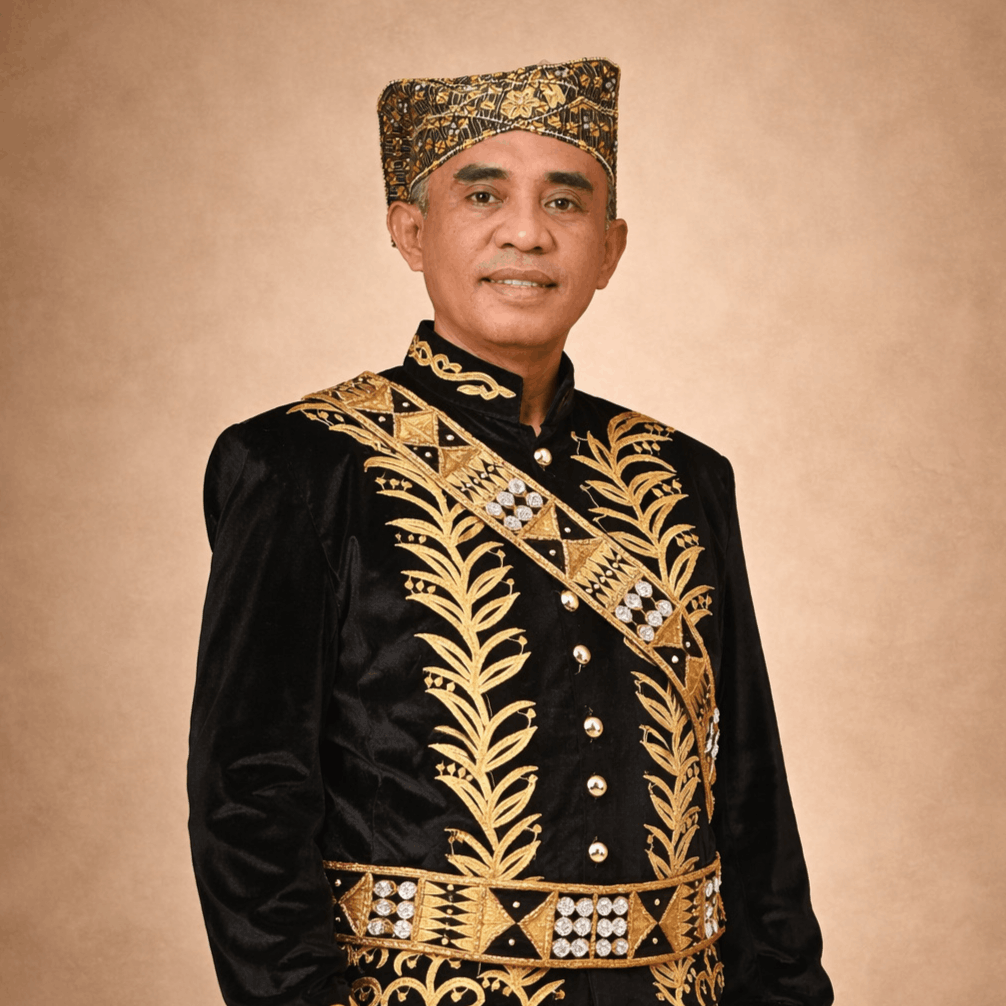
Within this landscape of values, the figure of Anwar Hafid, Governor of Central Sulawesi, is understood by many as Rilivuto Sulteng—a leader who upholds trust and devotion, rooted in spirituality and the local wisdom of the Kaili people.

Maroso Agama, Maroso Ada, Maroso Pamarentah, Naama Ngata, Nadeabelona.
(Strong religion, strong customs, and strong governance will give rise to a safe land and abundant goodness.)
The leadership commitment of the Chairman of Dunia Melayu Dunia Islam (DMDI) Central Sulawesi begins from the most sacred space in the life of the community: the mosque. From the mosque, the values of honesty, integrity, and advocacy for the weak are nurtured and strengthened. The mosque is not merely a place of worship, but a center for shaping leadership ethics—a place where a leader binds a moral promise before God and the people.
It is there that the commitment to clean, transparent, and just governance begins. In the Kaili cultural perspective, the relationship between government and the people is not a distant one. The ancestors of the Kaili have long taught: “Pamarentah and Todea are like the white and black of the eye, inseparable. If the people are in the water, the government is in the water. If the government is on land, the people are on land.”
Government and people are like the white and black of the eyeball—inseparable. If the people are in the water, the government is there as well. If the government is on land, the people are there too. This is not merely a proverb, but a philosophy of leadership that demands real presence, especially when the people are in hardship.
For Anwar Hafid, this value becomes the foundation for building modern governance that remains rooted in tradition. Clean governance is not only measured by systems and regulations, but by the moral courage to stand with the people above personal and group interests.
Just as the white and black of the eye complement each other to produce clear vision, so too must the people and their leaders unite to ensure that the direction of development remains straight and just. Without one or the other, balance will be lost.
From mosques to policy-making spaces, from religious values to the local wisdom of the Kaili people, the leadership of Panjaliku Ntodea Rilivuto in Central Sulawesi stands as a symbol of hope—that a clean, integrity-driven government that stands with the people is not a utopia, but a mandate that must be continuously upheld.

FROM SIGA TO MANDATE:
CENTRAL SULAWESI IN THE NETWORK OF THE MALAY AND ISLAMIC WORLD
Mutiara SIS Aljufri Airport in Palu that morning was not merely an arrival space. It transformed into a gateway of civilizations, a place where footsteps from the Malay and Islamic World network set foot on the land of Central Sulawesi. On Monday, January 27, 2026, the air of Palu welcomed the arrival of the President of the Malay World Islamic World (DMDI), Tun Seri Setia Dr. H. Mohd Ali bin Mohd Rustam, along with the Chairman of DMDI Indonesia, Datuk Haji Said Aldi Al Idrus, and Secretary General Mohammad Hasbi, together with the DMDI delegation.
At the arrival gate, the Governor of Central Sulawesi, Anwar Hafid, stood to welcome them. The reception was not merely ceremonial; it was framed by traditions and local wisdom that have long defined the identity of the Land of Tadulako. The Peulu Cinde dance was performed with movements that were gentle yet meaningful. In every step, there were prayers for safety, expressions of respect, and a declaration that culture is the first language of friendship. In that symbolically rich moment, Anwar Hafid placed the siga—the traditional headgear of Central Sulawesi—on the head of the DMDI President. A simple gesture that became a bridge of meaning between locality and global networks.
The placement of the siga marked both a traditional welcome and a symbol of brotherhood between the people of Central Sulawesi and the transnational Malay-Islamic community.
“Culture is the gateway to friendship among nations,” said Tun Seri Setia Dr. Mohd Ali bin Mohd Rustam. “DMDI is present to preserve heritage, while also building a future rooted in values.”
This visit is seen as strategic by the Provincial Government of Central Sulawesi. It opens spaces for dialogue, expands social and religious collaboration, and strengthens the region’s position within the network of Malay and Islamic civilization.


Inauguration:
A Mandate Within the Network of 27 Countries
The ballroom of Best Western Coco Hotel Palu witnessed an important moment. In a solemn atmosphere, Anwar Hafid was officially inaugurated as Chairman of DMDI Central Sulawesi Province for the 2025–2028 period.
The procession began with the Pajoge dance and the recitation of verses from the Holy Qur’an. Culture and spirituality blended together, forming a symbolic foundation for rooted leadership.
The Daily Chairman of DMDI Central Sulawesi, Suaib Djafar, reminded that DMDI, established in 2000, is now present in 29 countries, making it one of the largest Malay-Islamic networks in the world.
The Chairman of DMDI Indonesia, Datuk Haji Said Aldi Al Idrus, stated that this inauguration is special because it was conducted directly by the President of DMDI.
“This is a gateway to 27 DMDI member countries. The administrators inaugurated today must provide real benefits to the people of Central Sulawesi,” he emphasized. He also reminded that DMDI is not merely an organizational symbol. “DMDI is a gateway of brotherhood wherever we are. Do not only attend the inauguration, but support the DMDI chairman in building Central Sulawesi today and for the future.”
In front of government officials and international guests, Anwar Hafid accepted the mandate with composure. For him, a position is not the ultimate goal, but a responsibility that must be fulfilled.
“As long as I am still trusted, I will accept this mandate,” he said. “This is one way to bring Central Sulawesi to the global stage while preserving Malay values.”


In his view, DMDI serves as an instrument of cultural diplomacy. He interprets culture as soft power—a force that connects rather than compels; that builds an image without losing identity.
On that occasion, Anwar Hafid also received the Tun Perak Award as recognition for his commitment to encouraging the community and government officials to strengthen spiritual values through congregational prayers in mosques.
The President of DMDI expressed appreciation for Central Sulawesi’s resilience after the 2018 earthquake, tsunami, and liquefaction. “I admire the people of Central Sulawesi who continue to rise and remain competitive. This becomes the spirit to further strengthen DMDI.”

Quoting Surah Ash-Shaff verse 4 on the importance of unity, Tun Seri Setia emphasized that the Muslim community, numbering around two billion people, must move further forward. “Our countries are rich, we have many universities and numerous professors. But are we creating new innovations? We must build independence in knowledge and technology. Make Malays great again.”
From the ceremonial placing of the siga at the airport to the declaration of the mandate in the ballroom, the series of events formed a unified meaning. Central Sulawesi is not merely a host, but is taking its place within a global network—rooted in culture, oriented toward collaboration, and committed to inclusive progress for future generations.